

Towards greener HEP computing: measuring the energy efficiency of GPUs
Spanish researchers introduce energy efficiency as a metric to evaluate GPU hardware and software optimisation, helping pave the way towards more sustainable computing ecosystems for High Energy Physics.
1st September 2026 | Arantza Oyanguren (IFIC) and Jiahui Zhuo (UCAS)
The increasing computing demands of future High Energy Physics experiments make performance alone no longer sufficient when choosing the hardware that will power the next generation of scientific computing infrastructures. A new study by Jiahui Zhuo, Arantza Oyanguren, Álvaro Fernández Casani, Luca Fiorini and Valerii Kholoimov, recently published in Frontiers in Physics, addresses this challenge by introducing energy efficiency — the number of events processed per joule — as a metric to evaluate GPU-based computing systems. The study has been highlighted in major HEP conferences such as ICHEP 2026 and CHEP 2026.
The study takes as a real-world benchmark the first High-Level Trigger (HLT1) of the LHCb experiment at CERN, one of the pioneering large-scale applications of GPUs in High Energy Physics. During Run 3, around 500 NVIDIA RTX A5000 GPUs perform real-time reconstruction and event selection at the full 30 MHz proton-proton collision rate, processing an incoming data flow of approximately 40 Tb/s.
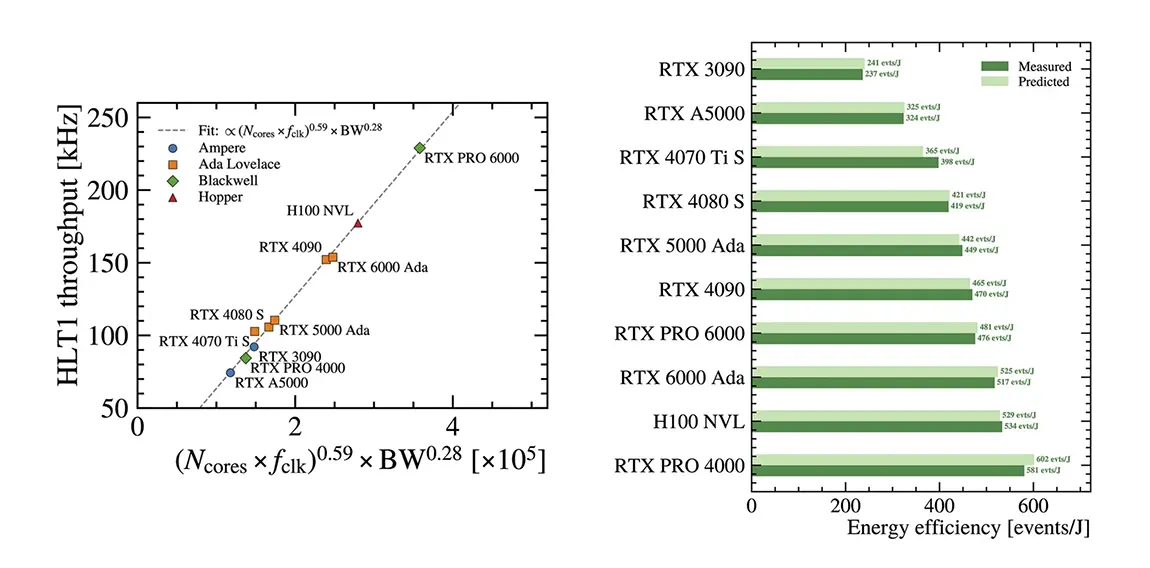
Using ten NVIDIA GPUs spanning four generations — Ampere, Ada Lovelace, Hopper and the latest Blackwell architecture — the researchers study how HLT1 performance depends on fundamental hardware characteristics such as the number of GPU cores, clock frequency and memory bandwidth. From these measurements, they develop predictive models for both throughput and power consumption, making it possible to estimate the expected performance and energy efficiency of different GPU models from their hardware specifications. The study is particularly relevant for guiding the selection and procurement of new computing devices in preparation for future LHC Runs.
Beyond the particular case of LHCb, the methodology provides a way to understand how efficiently scientific software exploits increasingly heterogeneous computing architectures. Such information can help experiments make informed decisions when selecting future hardware and, importantly, identify where software optimisation can deliver the greatest improvements.
The work, partially supported by the HIGH-LOW computing infrastructure at IFIC-Valencia, places sustainability alongside computing performance as a key consideration when designing future scientific computing systems. As the computing requirements of the HL-LHC era continue to grow, optimising not only how fast we process data, but also how much scientific computing we can perform for every joule of energy consumed, will become increasingly important.
The methodology developed in the study is not restricted to LHCb and can be extended to other High Energy Physics experiments, providing a useful tool towards building more efficient and sustainable computing ecosystems for future physics experiments.