

The ROOT Users Workshop 2025: A venue for everybody to share and discuss all things HEP computing!
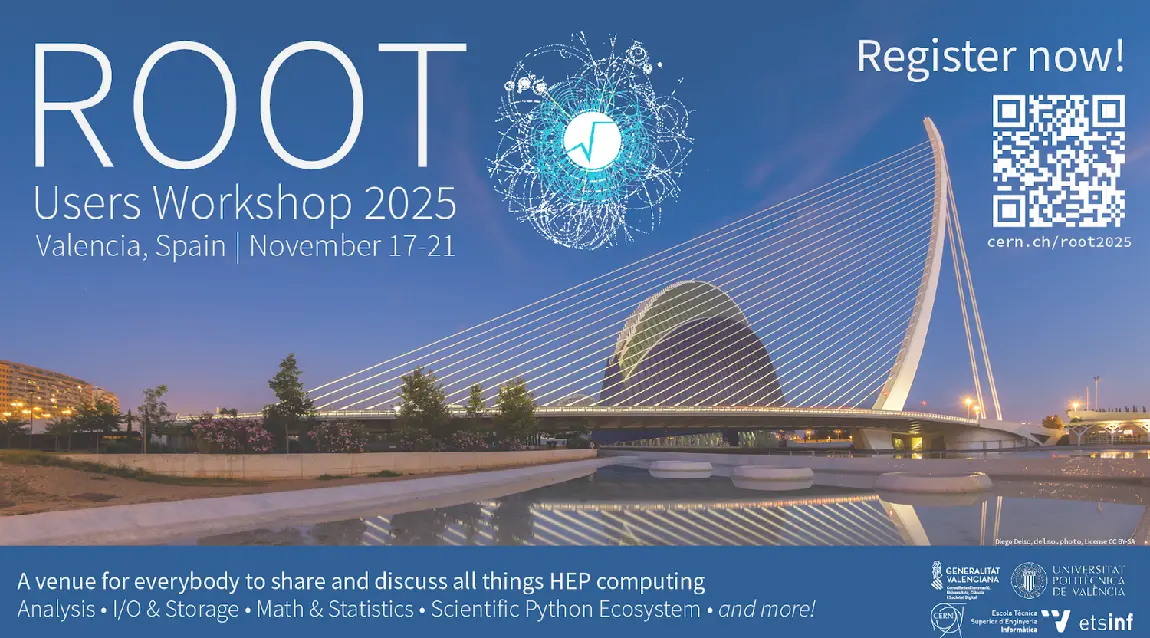
The ROOT team is looking forward to welcoming everyone interested to the event!
https://indico.cern.ch/event/1505384/
27 October 2025 | V. E. Padulano on behalf of the ROOT Project
ROOT is a unified software package for the storage, processing, and analysis of scientific data. It is aimed at, but not limited to, the computing challenges of experimental physics experiments.
ROOT provides a very efficient storage system for data models, which has been demonstrated to work at scale at the CERN Large Hadron Collider (LHC) experiments: exabytes of scientific data are written in the columnar ROOT format. ROOT comes with capabilities of histogramming in an arbitrary number of dimensions, curve fitting, statistical modelling, minimization, to allow the easy setup of a data analysis system that can query and process the data interactively or in batch mode, as well as a general parallel processing framework, RDataFrame, that can considerably speed up an analysis, taking full advantage of multi-core and distributed systems.
ROOT is performance critical software written in C++ and enables rapid prototyping powered by a unique C++ compliant interpreter called Cling. Cling also enables performant C++ type introspection which is a building block of automatic interoperability with Python. Thanks to its dynamic Python bindings, leveraging the cppyy technology, ROOT offers efficient, on-demand C++/Python interoperability in a uniform cross-language execution environment.
ROOT is open-source software, powered by an international collaboration with core contributions by CERN, FermiLab, UCSD, Princeton University, GSI.
As the software project turns 30, it is poised to address the new challenges brought by the next update of the LHC, namely High Luminosity LHC, which is expected to begin in 2030 and provide an order of magnitude more data to process than ever collected before. At the core of the strategy for addressing these challenges is a new, modernized data format called RNTuple, which will provide a smaller on-disk size to store the same information while also being much faster to read and write. At the same time, all major areas of ROOT are undergoing a streamlining, modernization and improvement process that will culminate in a new major version of the project resulting in a faster, safer, more easily usable and even more reliable product for the high performance computing requirements of the future.
Given the variety of new needs and use cases that the future holds for the Experimental Physics community, as well as other scientific communities, the ROOT core team is excited to propose the ROOT Users Workshop 2025, an event taking place in Valencia, Spain, between 17th and 21st November.
The workshop is a venue for all ROOT users and various scientific communities, from students and early career scientists, to world-class experts of physics and scientific computing as well as the ROOT core developers with the goal of exchanging ideas and learning from each other. The rich scientific program includes: talks by various experiments representatives of different areas, including LHC and other Physics experiments such as DUNE, JUNO, BelleII, as well as topical sessions about data analysis, storage and I/O, statistical modeling and likelihood estimation, scientific Python and programming language interoperability.