
Great Success of the 4th COMCHA School
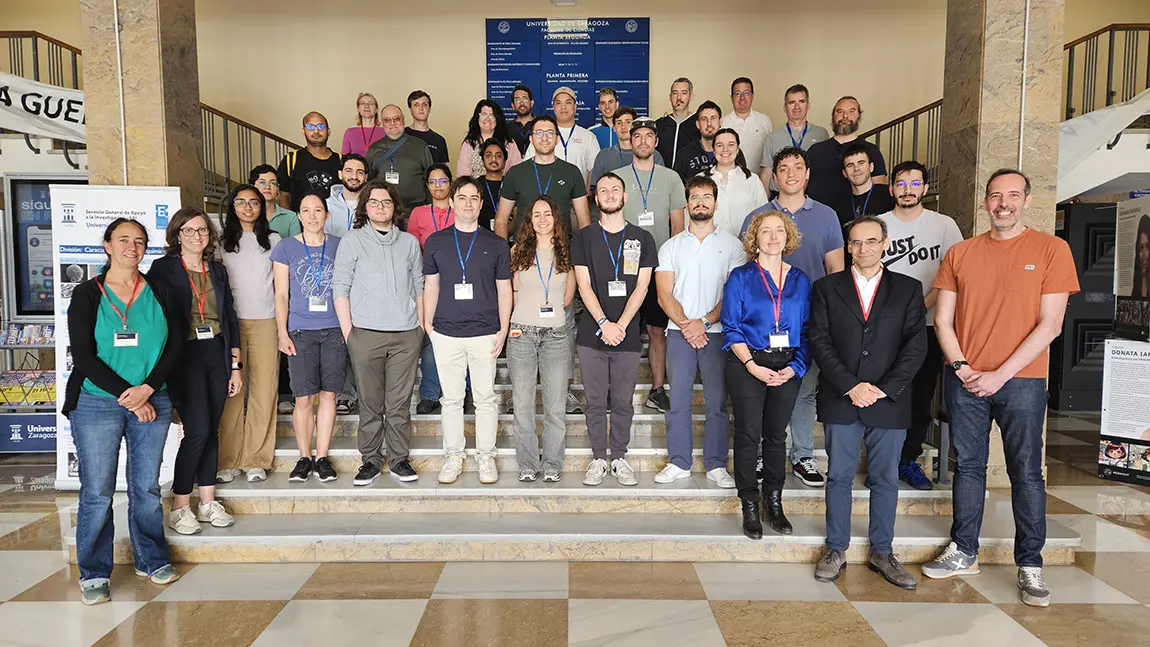
The 4th COMCHA School, held in Zaragoza from April 8th to 15th, concluded with outstanding success, bringing together researchers and students for an intensive week of learning and collaboration.
16th April 2026 | L. Fiorini and A. Oyanguren
The event gathered more than 50 participants from a wide range of institutions and backgrounds, with particularly strong and highly appreciated contributions from Spanish and international speakers. The school created a vibrant and interactive environment among the lecturers and the students.
Throughout the week, 28 attendees engaged in a high-quality programme of lectures delivered by leading experts, covering both fundamental concepts and recent advances in computing for High Energy Physics and related fields. The programme included more than 45 hours of training, with approximately 40% dedicated to hands-on sessions. The school represents a cutting-edge training initiative on computing technologies: beyond Machine Learning (F. Luan – UB), it featured practical sessions in Large Language Models (U. Perez – URL), quantum computing (M. Lucio – IFIC), and programming for heterogeneous computing architectures such as FPGAs (A. Navarro – CIEMAT) and GPUs (M.A. Martínez del Amor – Sevilla University), as well as simulations (C. Vico – Rice University), which is an uncommon combination in comparable schools. Students learnt how to perform optimized programming (J. Zhuo – IFIC) and the important differences that offline (E. Torró – IFIC) and real time computing (C. Marín – UB) have to face.
“The COMCHA school offers early-career scientists and engineers a valuable opportunity to understand the software and computing needs of fundamental physics, while also fostering connections that may lead to future interdisciplinary collaborations.” emphasizes Gonzalo Merino, a leading expert in distributed computing and data management for High Energy Physics at PIC (Port d’Informació Científica) in Barcelona.
“This school covers technology that touches on a wide range of scientific pursuits, and at the same time exposes students to real-world applications.” affirms David Lange (Princeton University), a recognised leader in scientific software for High Energy Physics and principal investigator of NSF-funded initiatives, lecturer of the school.
The remarkable success of the school is undoubtedly due to the outstanding local organising committee, led by Héctor Gómez Maluenda and supported by Iván Coarasa, Theopisti Dafni, Gloria Luzón, María Martínez, Siannha Peñaranda and Laura Seguí from the newly created CAPA institute of the Zaragoza University.
“CAPA is fully aware of the computational challenges that the field of physics will face in the coming years. Joining the COMCHA network will undoubtedly help us address these challenges in the most effective way possible. As recent members of the network, it has been a great opportunity and a privilege to organize this school, as it has allowed us to establish much closer connections with other COMCHA members and to strengthen CAPA’s commitment to the professional development of early-career researchers. Moreover, we conclude the school with a very positive feeling, as we believe it has achieved its intended objectives and has been a true success, as we can conclude by the feedback from both speakers and students.” says Héctor Gómez, IP of the Aragon node of the COMCHA network who has recently become the new IAXO software coordinator at DESY.
The lectures were opened by V. Chobanova (UdC) and on the first day special attention was given to the Spanish computing infrastructures Artemisa (J.E. Navarro – IFIC), PIC (G. Merino) and Agustina (S. Martínez – BIFI). Students had exceptional access to the GPU infrastructure at IFIC and the GPU programming lectures provided them with a very valuable official NVIDIA certificate.
As an additional highlight of this edition, the school also benefited from the participation of CAPA theorists, who contributed lectures on the computational challenges of lattice QCD (A. Vaquero) and on the strategies used in phenomenology to perform global fits (J. Alda).
Continuing the approach of previous editions, the school aimed to strengthen the interplay between academia and industry, and we gratefully acknowledge the valuable contribution of José Juste (BSH Spain), who shared insights on the use of artificial intelligence (AI) in an industrial context. This is a topic of clear relevance to the students’ potential future career paths.
The objective of the COMCHA School is to train participants in new and advanced computing technologies. New AI techniques were presented by D. Rousseau (IJCLab), while L. Moneta (CERN) discussed recent developments in foundation models. Core topics of the programme also included modern Bayesian inference (B. Zaldívar, IFIC) and differential computing (P. Vischia – IFCA).
The week was also made memorable by the excellent food in Zaragoza, a highlight that was thoroughly enjoyed by all!
We would like to warmly thank all participants, excellent students, and organisers for their commitment and enthusiasm, which made this event possible, including the support of the IFIC Severo Ochoa and Zaragoza University.
Pictures of the school can be found here.